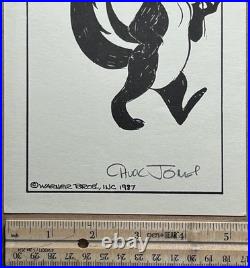
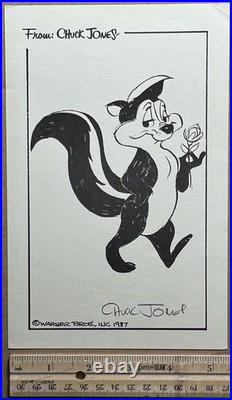
CHUCK JONES-SIGNED Pepe Le Pew PRINT-OSCAR WINNING ANIMATOR-Road Runner+Bugs
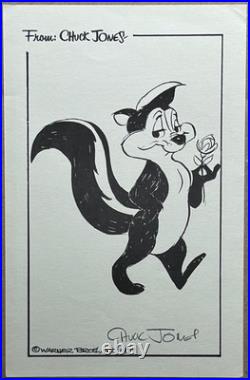

Charles Martin Jones (September 21, 1912 - February 22, 2002) was an American animator, filmmaker, painter, and voice actor, best known for his work with Warner Bros. Cartoons on the Looney Tunes and Merrie Melodies series of shorts. He wrote, produced, and/or directed many classic animated cartoon shorts starring Bugs Bunny, Daffy Duck, Wile E. Coyote and the Road Runner, Pepé Le Pew, Marvin the Martian, and Porky Pig, among others. Jones started his career in 1933 alongside Tex Avery, Friz Freleng, Bob Clampett, and Robert McKimson at the Leon Schlesinger Production's Termite Terrace studio, the studio that made Warner Brothers cartoons, where they created and developed the Looney Tunes characters.
After his career at Warner Bros. Seuss's How the Grinch Stole Christmas!
(1966) and Horton Hears a Who! He later started his own studio, Chuck Jones Enterprises, where he directed and produced the film adaptation of Norton Juster's The Phantom Tollbooth (1970). Jones's work along with the other animators was showcased in the documentary Bugs Bunny: Superstar (1975). Jones directed the first feature-length animated Looney Tunes compilation film, The Bugs Bunny/Road Runner Movie (1979). In 1990 he wrote his memoir, Chuck Amuck: The Life and Times of an Animated Cartoonist, which was made into a documentary film, Chuck Amuck (1991). He was also profiled in the American Masters documentary Chuck Jones: Extremes & Inbetweens - A Life in Animation (2000) which aired on PBS. Two Warner Brothers cartoons that Jones directed, For Scent-imental Reasons and So Much for So Little, won Academy Awards for Best Animated Short Film, though at this time it was customary for the statuette to be given to a cartoon's producer, not the director. Jones did not receive a Best Animated Short Film Oscar of his own until winning for The Dot and the Line in 1966. Robin Williams later presented Jones with an Honorary Academy Award in 1996 for his work in the animation industry. Film historian Leonard Maltin has praised Jones's work at Warner Bros. MGM and Chuck Jones Enterprises.In Jerry Beck's 1994 book The 50 Greatest Cartoons, a group of animation professionals ranked What's Opera, Doc? (1957) as the greatest cartoon of all time, with ten of the entries being directed by Jones including Duck Amuck (1953), Duck Dodgers in the 24½th Century (1953), One Froggy Evening (1955), Rabbit of Seville (1950), and Rabbit Seasoning (1952). Charles Martin Jones was born on September 21, 1912, in Spokane, Washington, to Mabel McQuiddy (née Martin) and Charles Adams Jones. When he was six months old, he moved with his parents and three siblings to Los Angeles, California.
In his autobiography, Chuck Amuck, Jones credits his artistic bent to circumstances surrounding his father, who was an unsuccessful businessman in California in the 1920s. He recounted that his father would start every new business venture by purchasing new stationery and new pencils with the company name on them. When the business failed, his father would quietly turn the huge stacks of useless stationery and pencils over to his children, requiring them to use up all the material as fast as possible. The children drew frequently, owing to the abundance of high-quality paper and pencils.
Later, in one art school class, the professor gravely informed the students that they each had 100,000 bad drawings in them that they must first get past before they could possibly draw anything worthwhile. Jones recounted years later that this pronouncement came as a great relief to him, as he was well past the 200,000 mark, having used up all that stationery. Jones and several of his siblings went on to artistic careers. During his artistic education, he worked part-time as a janitor.
He worked his way up in the animation industry, starting as a cel washer; then I moved up to become a painter in black and white, some color. Then I went on to take animator's drawings and traced them onto the celluloid.
Then I became what they call an in-betweener, which is the guy that does the drawing between the drawings the animator makes. While at Iwerks, he met a cel painter named Dorothy Webster, who later became his first wife.
See also: Chuck Jones filmography. Jones joined Leon Schlesinger Productions, the independent studio that produced Looney Tunes and Merrie Melodies for Warner Bros. Pictures, in 1933 as an assistant animator. In 1935 he was promoted to animator and assigned to work with a new Schlesinger director, Tex Avery. There was no room for the new Avery unit in Leon Schlesinger's small studio, so Avery, Jones, and fellow animators Bob Clampett, Virgil Ross, and Sid Sutherland were moved into a small adjacent building they dubbed "Termite Terrace".
In 1937, Jones' old boss Ub Iwerks was subcontracted to produce several Looney Tunes shorts for Schlesinger, with Clampett and Jones brought in to assist him. Iwerks completed only two shorts before he left, with Clampett taking his position soon after. Jones worked alongside Clampett as an animator and an uncredited co-director (or "supervisor", the original title for an animation director in the studio) before becoming a main director himself in 1938 when Frank Tashlin left the studio, a position that was initially offered to animator Robert McKimson. The following year, Jones created his first major character, Sniffles, a cute Disney-style mouse, who went on to star in twelve Warner Bros. Jones initially struggled in with his directorial style in his formative years. Unlike the other directors in the studio, Jones wanted to make cartoons that would rival the quality and tone to that of ones made by Walt Disney Productions. However, his cartoons suffered from sluggish pacing and confusing gags, with Jones himself later describing his early conception of timing and dialog to have been "formed by watching the action in the La Brea Tar Pits". Schlesinger and the studio heads were unsatisfied with his Disney-esque style and demanded him make cartoons that were more funny. Jones began to change of directorial style starting with the 1942 short The Draft Horse, but the cartoon that was generally considered his true turning point was The Dover Boys later that year.The short became highly regarded in recent years for its quick-timed gags and extensive use of limited animation. Despite this, Schlesinger and the studios heads were still dissatisfied and begun the process to fire him, but they were unable to find a replacement due to a labor shortage stemming from World War II, so Jones kept his position. Jones was actively involved in efforts to unionize the staff of Leon Schlesinger Productions. He was responsible for recruiting animators, layout men, and background people.
Almost all animators joined, in reaction to salary cuts imposed by Schlesinger. The Metro-Goldwyn-Mayer cartoon studio had already signed a union contract, encouraging their counterparts under Schlesinger.In a meeting with his staff, Schlesinger talked for a few minutes, then turned over the meeting to his attorney. His insulting manner had a unifying effect on the staff.
Jones gave a pep talk at the union headquarters. As negotiations broke down, the staff decided to go on strike. Schlesinger locked them out of the studio for a few days, before agreeing to sign the contract. A Labor-Management Committee was formed and Jones served as a moderator. Because of his role as a supervisor in the studio, he could not himself join the union.
Duration: 5 minutes and 9 seconds. Outpost, a Private Snafu cartoon directed by Chuck Jones in 1944. During World War II, Jones worked closely with Theodor Geisel, better known as Dr.
Seuss, to create the Private Snafu series of Army educational cartoons (the character was created by director Frank Capra). Jones later collaborated with Seuss on animated adaptations of Seuss' books, including How the Grinch Stole Christmas! Jones directed such shorts as The Weakly Reporter, a 1944 short that related to shortages and rationing on the home front. During the same year, he directed UPA's second short subject Hell-Bent for Election, a propaganda campaign film for Franklin D.
Jones created characters through the late 1930s, late 1940s, and the 1950s, which include his collaborative help in co-developing Bugs Bunny and also included creating Claude Cat, Marc Antony and Pussyfoot, Charlie Dog, Michigan J. Frog, Gossamer, and his four most popular creations, Marvin the Martian, Pepé Le Pew, Wile E. Coyote and the Road Runner.
Jones and writer Michael Maltese collaborated on the Road Runner cartoons, Duck Amuck, One Froggy Evening, and What's Opera, Doc? Other staff at Unit A with whom Jones collaborated include layout artist, background designer, and co-director Maurice Noble; animator and co-director Abe Levitow; and animators Ken Harris and Ben Washam. Jones remained at Warner Bros. Throughout the 1950s, except for a brief period in 1953 when Warner closed the animation studio. During this interim, Jones found employment at Walt Disney Productions, where he teamed with Ward Kimball for four months. According to Kimball, Jones expected to work at Disney at a higher salary then at Warner Bros. But was instead employed at the same salary despite numerous negotiations with Walt Disney.Furthermore, Jones was not given directorial assignments but was instead assigned to assist Kimball on Sleeping Beauty (1959), which at the time was enduring production delays. Cartoons reopening, Jones was rehired and reunited with most of his unit. Despite the unsatisfying tenure, Jones still held the Disney studio in high regard, but later joked that the only job worth having at Disney belonged to Walt.
In the early 1960s, Jones and his wife Dorothy wrote the screenplay for the animated feature Gay Purr-ee. The finished film included the voices of Judy Garland, Robert Goulet, and Red Buttons as cats in Paris. The feature was produced by UPA and directed by Jones' former Warner Bros. Jones was moonlighting to work on the film as he had an exclusive contract with Warner Bros. UPA completed the film and made it available for distribution in 1962, whereupon it was picked up by Warner Bros.
Discovered that Jones had violated his exclusive contract with them, they terminated him. Jones's former animation unit was laid off after completing the final cartoon in their pipeline, The Iceman Ducketh, and the rest of the Warner Bros. Cartoons studio was closed in 1963. With business partner Les Goldman, Jones started an independent animation studio, Tower 12, Inc.
(later Sib Tower 12 Productions after Walter Bien's SIB Productions took over), and brought on most of his unit from Warner Bros. Including Maurice Noble and Michael Maltese. In 1963, Metro-Goldwyn-Mayer contracted with Sib Tower 12 to have Jones and his staff produce new Tom and Jerry cartoons as well as a television adaptation of all Tom and Jerry theatricals produced to that date. This included major editing, including writing out the African-American maid, Mammy Two-Shoes, and replacing her with one of Irish descent voiced by June Foray. In 1964, Sib Tower 12 was absorbed by MGM and was renamed MGM Animation/Visual Arts.His animated short film, The Dot and the Line: A Romance in Lower Mathematics, won the 1965 Academy Award for Best Animated Short Film. Jones directed the classic animated short The Bear That Wasn't. In 1966, he produced and directed the TV special How the Grinch Stole Christmas!
Featuring narration by Boris Karloff. Jones continued to work on other TV specials such as Horton Hears a Who! (1970), but his main focus during this time was producing the feature film The Phantom Tollbooth, which did lukewarm business when MGM released it in 1970. Jones co-directed 1969's The Pogo Special Birthday Special, based on the Walt Kelly comic strip, and voiced the characters of Porky Pine and Bun Rab. It was at this point that he decided to start ST Incorporated.
MGM closed the animation division in 1970, and Jones once again started his own studio, Chuck Jones Enterprises. He produced a Saturday morning children's TV series for the American Broadcasting Company called Curiosity Shop in 1971. In 1973, he produced an animated version of the George Selden book The Cricket in Times Square and subsequently produced two sequels. Three of his works during this period were animated TV adaptations of short stories from Rudyard Kipling's The Jungle Book: Mowgli's Brothers, The White Seal and Rikki-Tikki-Tavi. During this period, Jones began to experiment with more realistically designed characters, most of which had larger eyes, leaner bodies, and altered proportions, such as those of the Looney Tunes characters.
Jones resumed working with Warner Bros. In 1976 with the animated TV adaptation of The Carnival of the Animals with Bugs Bunny and Daffy Duck. Jones also produced The Bugs Bunny/Road Runner Movie (1979), which was a compilation of Jones's best theatrical shorts, new Road Runner shorts for The Electric Company series and Bugs Bunny's Looney Christmas Tales (1979). New shorts were made for Bugs Bunny's Bustin' Out All Over (1980). From 1977 to 1978, Jones wrote and drew the newspaper comic strip Crawford (also known as Crawford & Morgan) for the Chicago Tribune-NY News Syndicate.In 2011 IDW Publishing collected Jones's strip as part of their Library of American Comic Strips. On December 11, 1975, a week before the release of Bugs Bunny: Superstar, which prominently featured Bob Clampett, Jones wrote a letter to Tex Avery, accusing Clampett of taking credit for ideas that were not his, and for characters created by other directors (notably Jones's Sniffles and Friz Freleng's Yosemite Sam).
Their correspondence was never published in the media. It was forwarded to Michael Barrier, who had conducted the interview with Clampett, and over the years Jones distributed it to multiple people concerned with animation. When he was a kid, Jones loved to read any fiction and non-fiction authors such as Charles Dickens and Rudyard Kipling, his favorite being Mark Twain.He also liked cinema, mainly admiring the works of Laurel & Hardy, Charlie Chaplin, Buster Keaton and The Marx Brothers. His main graphic influence was Winsor McCay, and he later cited Walt Disney and Tex Avery, as well as comic artist Ronald Searle.
In 1978, Jones's wife Dorothy died. He married Marian Dern, the writer of the comic strip Rick O'Shay in 1981. Jones was the creative consultant and character designer for two Raggedy Ann animated specials and the first Alvin and the Chipmunks Christmas special A Chipmunk Christmas. He made a cameo appearance in the film Gremlins (1984) and he wrote and directed the Bugs Bunny/Daffy Duck animated sequences that bookend its sequel Gremlins 2: The New Batch (1990). Jones directed animated sequences for various features such as a lengthy sequence in the film Stay Tuned (1992) and a shorter one seen at the start of the Robin Williams vehicle Mrs.
Also during the 1980s and 1990s, Jones served on the advisory board of the National Student Film Institute. In 1993, he started Chuck Jones Film Productions with a contract at Warner Bros.
To produce new animated Looney Tunes shorts for theatrical release. The venture was later dissolved in 1996. Jones's final Looney Tunes cartoon was From Hare to Eternity (1997), which starred Bugs Bunny and Yosemite Sam, with Greg Burson voicing Bugs. The cartoon was dedicated to Friz Freleng, who had died in 1995. Jones's final animation project was a series of 13 shorts starring a timber wolf character he had designed in the 1960s named Thomas Timber Wolf.The series was released online by Warner Bros. From 2001 until 2004, Cartoon Network aired The Chuck Jones Show which features shorts directed by him. The show won the Annie Award for Outstanding Achievement in an Animated Special Project.
In 1997, Jones was awarded the Edward MacDowell Medal. In 1999, he founded the non-profit Chuck Jones Center for Creativity, in Costa Mesa, California, an art education "gymnasium for the brain" dedicated to teaching creative skills, primarily to children and seniors, which is still in operation.
In his later years, he recovered from skin cancer and received hip and ankle replacements. Jones died of congestive heart failure on February 22, 2002, at his home in Corona del Mar, Newport Beach at the age of 89. He was cremated and his ashes were scattered at sea. The Night Watchman (1938) (director). Dog Gone Modern (1939) (director). Robin Hood Makes Good (1939) (director). Daffy Duck and the Dinosaur (1939) (director). Naughty but Mice (1939) (director). Snowman's Land (1939) (director). Little Brother Rat (1939) (director).The Little Lion Hunter (1939) (director). The Good Egg (1939) (director).
Sniffles and the Bookworm (1939) (director). The Curious Puppy (1939) (director). Elmer's Candid Camera (1940) (director).Sniffles Takes a Trip (1940) (director). Tom Thumb in Trouble (1940) (director). The Egg Collector (1940) (director). Good Night Elmer (1940) (director).
Bedtime for Sniffles (1940) (director). Elmer's Pet Rabbit (1941) (director). Sniffles Bells the Cat (1941) (director). Joe Glow, the Firefly (1941) (director).
Porky's Ant (1941) (director). Porky's Prize Pony (1941) (director). Inki and the Lion (1941) (director). Snowtime for Comedy (1941) (director). The Brave Little Bat (1941) (director).
Porky's Midnight Matinee (1941) (director). Porky's Cafe (1942) (director). Conrad the Sailor (1942) (director).
The Draft Horse (1942) (director). Hold the Lion, Please (1942) (director).The Squawkin' Hawk (1942) (director). The Dover Boys at Pimento University (1942) (director). My Favorite Duck (1942) (director).
Case of the Missing Hare (1942) (director). To Duck or Not to Duck (1943) (director).
Flop Goes the Weasel (1943) (director). The Unbearable Bear (1943) (director).
Fin'n Catty (1943) (director). Inki and the Minah Bird (1943) (director). Tom Turk and Daffy (1944) (director). Bugs Bunny and the Three Bears (1944) (director).The Weakly Reporter (1944) (director). From Hand to Mouse (1944) (director). Lost and Foundling (1944) (director).
Trap Happy Porky (1945) (director). Hush My Mouse (1946) (director). The Eager Beaver (1946) (director). Fair and Worm-er (1946) (director).
Scent-imental Over You (1947) (director). Inki at the Circus (1947) (director). A Pest in the House (1947) (director). Little Orphan Airedale (1947) (director). House Hunting Mice (1948) (director).
A Feather in His Hare (1948) (director). You Were Never Duckier (1948) (director). My Bunny Lies over the Sea (1948) (director). The Bee-Deviled Bruin (1949) (director). Often an Orphan (1949) (director).
Fast and Furry-ous (1949) (director). For Scent-imental Reasons (1949) (director). The Scarlet Pumpernickel (1950) (director). 8 Ball Bunny (1950) (director). Dog Gone South (1950) (director).
Rabbit of Seville (1950) (director). Two's a Crowd (1950) (director).
A Hound for Trouble (1951) (director). The Wearing of the Grin (1951) (director). A Bear for Punishment (1951) (director). Feed the Kitty (1952) (director). Little Beau Pepé (1952) (director). Water, Water Every Hare (1952) (director). Orange Blossoms for Violet (1952) (director). The Hasty Hare (1952) (director). Don't Give Up the Sheep (1953) (director). Forward March Hare (1953) (director). Kiss Me Cat (1953) (director). Much Ado About Nutting (1953) (director). Wild Over You (1953) (director). Duck Dodgers in the 24½th Century (1953) (director). Bully for Bugs (1953) (director). The Cat's Bah (1954) (director). Claws for Alarm (1954) (director).From A to Z-Z-Z-Z (1954) (director). My Little Duckaroo (1954) (director).
Baby Buggy Bunny (1954) (director). Double or Mutton (1955) (director). Two Scent's Worth (1955) (writer and director). One Froggy Evening (1955) (director). A Hitch in Time (1955) (director).
Heaven Scent (1956) (writer and director). Barbary Coast Bunny (1956) (director). Deduce, You Say (1956) (director). To Hare Is Human (1956) (director).
Ali Baba Bunny (1957) (director). Go Fly a Kit (1957) (director). Zoom and Bored (1957) (director). Touché and Go (1957) (director).Robin Hood Daffy (1958) (director). Hare-Way to the Stars (1958) (director).
To Itch His Own (1958) (director). Hook, Line and Stinker (1958) (director). Baton Bunny (1959) (director with Abe Levitow). Wild About Hurry (1959) (director).Fastest with the Mostest (1960) (director). Rabbit's Feat (1960) (director). Ready, Woolen and Able (1960) (director).
Hopalong Casualty (1960) (writer and director). Zip'N Snort (1961) (writer and director). The Mouse on 57th Street (1961) (director). The Abominable Snow Rabbit (1961) (director with Maurice Noble). Lickety-Splat (1961) (writer, director with Abe Levitow).
A Scent of the Matterhorn (1961) writer & director, credited as M. Compressed Hare (1961) (director with Maurice Noble). Beep Prepared (1961) (writer with John Dunn, director with Maurice Noble). Nelly's Folly (1961) (writer with David Detiege, director with Abe Levitow & Maurice Noble). A Sheep in the Deep (1962) (writer, director with Maurice Noble).Zoom at the Top (1962) (writer, director with Maurice Noble). Louvre Come Back to Me! (1962) (director with Maurice Noble). Martian Through Georgia (1962) (writer with Carl Kohler, director with Abe Levitow & Maurice Noble). I Was a Teenage Thumb (1963) (writer with John Dunn, director with Maurice Noble).
Now Hear This (1963) (writer with John Dunn, director with Maurice Noble). Woolen Under Where (1963) (writer). Hare-Breadth Hurry (1963) (director with Maurice Noble).
Mad as a Mars Hare (1963) (director with Maurice Noble). Transylvania 6-5000 (1963) (director with Maurice Noble). To Beep or Not to Beep (1963) (writer with John Dunn, director with Maurice Noble & Tom Ray).The Iceman Ducketh (1964) (uncredited director with Phil Monroe & Maurice Noble). War and Pieces (1964) (director with Maurice Noble).
Gateways of the Mind (1958) (animated sequences directed by Chuck Jones and designed by Maurice Noble). The Bugs Bunny Show (1960-62).
Adventures of the Road Runner (1962) (writer with John Dunn & Michael Maltese, director with Maurice Noble & Tom Ray). This unsuccessful television pilot was later broken up into three theatrical cartoons.
To Beep or Not to Beep (released as a theatrical short in 1963). Zip Zip Hooray (Jones not involved). Road Runner a Go-Go (Jones not involved). Point Rationing of Foods (1943).
A Lecture on Camouflage (1944). The Good Egg (1945) (not to be confused with the 1939 cartoon of the same title). It's Murder She Says (1945).Secrets of the Caribbean (1945). So Much for So Little (1949). 90 Days Wondering (1956) (Ralph Phillips). At United Productions of America. Hell-Bent for Election (1944) (produced for United Auto Workers).
Gay Purr-ee (1962, in conjunction with UPA). Jones was sacked by Warner Bros Cartoons after they found out about Jones involvement with this film. Pent-House Mouse (producer, writer with Michael Maltese, director with Maurice Noble).
The Cat Above and The Mouse Below (producer, writer with Michael Maltese, director with Maurice Noble). Is There a Doctor in the Mouse?
(producer, writer with Michael Maltese, director with Maurice Noble). Much Ado About Mousing (producer, director with Maurice Noble). Snowbody Loves Me (producer, writer with Michael Maltese, director with Maurice Noble).
The Unshrinkable Jerry Mouse (producer, writer with Michael Maltese, director with Maurice Noble). Ah, Sweet Mouse-Story of Life (producer, writer with Michael Maltese, director with Maurice Noble). Tom-ic Energy (producer, writer with Michael Maltese, director with Maurice Noble). Bad Day at Cat Rock (producer & writer, director with Maurice Noble). The Brothers Carry-Mouse-Off (producer, writer with Jim Pabian). Haunted Mouse (producer, writer with Jim Pabian, director with Maurice Noble). I'm Just Wild About Jerry (producer, writer with Michael Maltese, director with Maurice Noble). Of Feline Bondage (producer, writer with Don Towsley, director with Maurice Noble). The Year of the Mouse (producer, writer with Michael Maltese, director with Maurice Noble). Duel Personality (producer, writer with Michael Maltese, director with Maurice Noble).Jerry, Jerry, Quite Contrary (producer & writer, director with Maurice Noble). Jerry-Go-Round (producer, uncredited director with Abe Levitow & Maurice Noble, the latter of which was also uncredited). Love Me, Love My Mouse (producer, director with Ben Washam). Catty-Cornered (producer, uncredited director with Abe Levitow, uncredited writer with John Dunn & Michael Maltese, the latter of which was also uncredited).
Cat and Dupli-cat (producer, writer with Michael Maltese, director with Maurice Noble). Cannery Rodent (producer & writer, director with Maurice Noble). Shutter Bugged Cat (uncredited producer). Advance and Be Mechanized (producer). Purr-Chance to Dream (producer, uncredited director with Ben Washam, uncredited writer with Irv Spector & Michael Maltese, the latter of which was also uncredited).
The Dot and the Line (1965) Oscar winner (producer with Les Goldman, director with Maurice Noble). The Bear That Wasn't (1967) (co-producer with Frank Tashlin despite Tashlin having no involvement in the film's production, although he did write the book), director with Maurice Noble. The Phantom Tollbooth (1970) (co-producer with Les Goldman & Abe Levitow, screenplay with Sam Rosen, director with Abe Levitow & Dave Monahan). Tom and Jerry (1965) (titles, bumpers, and reanimating offensive content from the following Hanna-Barbera shorts: The Little Orphan, Saturday Evening Puss, The Framed Cat, Dog Trouble, The Truce Hurts, Triplet Trouble, Push-Button Kitty, Nit-Witty Kitty). How the Grinch Stole Christmas!
(1966) (co-produced with Ted Geisel, director with Ben Washam). The Pogo Special Birthday Special (1969) (co-produced with Walt Kelly, director with Ben Washam, voice actor). (1970) (storyboard artist with Bob Ogle, producer with Ted Geisel, director with Ben Washam, voice actor).
The Cat in the Hat (1971, in conjunction with DePatie-Freleng Enterprises1) (storyboard artist, producer with Ted Geisel). 1 Jones left the production of this special before it was finished after a rift with Geisel, DePatie-Freleng completed the special. Content production suspended after 1997. Los Angeles, California, United States. Doubtfire (1993) (animation opening sequence only, Pudgy & Grunge).
Curiosity Shop (1971-72) (executive producer). Man the Polluter (1973) (animation sequence directed by). The Cricket in Times Square (1973).
A Very Merry Cricket (1973). Raggedy Ann and Andy in The Great Santa Claus Caper (1978). Raggedy Ann and Andy in The Pumpkin Who Couldn't Smile (1979). A Chipmunk Christmas (1981) (character designer and creative consultant, co-produced with Bagdasarian Productions).
Peter and the Wolf (1995). The Bugs Bunny/Road Runner Movie (1979) (Original bridge animation only). Gremlins 2: The New Batch (1990) animated opening and end credits, featuring Daffy Duck and Bugs Bunny, co-produced with Warner Bros. Stay Tuned (1992) Robocat segment of Rooney Tunes, co-produced with Warner Bros.
Chariots of Fur (1994) (producer with Linda Jones Clough, writer and director). Another Froggy Evening (1995) producer with Linda Jones Clough, writer with Don Arioli, Stephen A. Fossati, and Stan Freberg, director.
Superior Duck (1996) (producer with Linda Jones Clough, writer and director). Father of the Bird (1997) (producer with Linda Jones Clough). Pullet Surprise (1997) (producer with Linda Jones Clough). From Hare to Eternity (1997) (producer with Linda Jones Clough, director). The Electric Company (1971) Wile E. Coyote and Road Runner segments only.Bugs and Daffy's Carnival of the Animals (1976) (All-new special featuring Bugs Bunny and Daffy Duck). Bugs Bunny in King Arthur's Court (1978) (All-new special featuring Bugs Bunny and Daffy Duck). Bugs Bunny's Looney Christmas Tales (1979) (Co-produced by DePatie-Freleng Enterprises). Bugs Bunny's Bustin' Out All Over (1980). Daffy Duck's Thanks-for-Giving (1980).